And for good reason. Every couples app is an account, a cloud, and a server full of your most personal data, sitting somewhere you can't see. The honest answer to "where does this go?" has always been "trust us, it's encrypted on our servers."
In this category, that has never felt like enough. A breach, a subpoena, an acquisition, a policy change — the data is still out there, on someone else's computer, tied to the two of you.
So Papaya is built the other way around. There is no server to trust — because there isn't one.
Place your iPhone nearby and start a private session. The screen dims so it stops glowing — you forget it's there.
Papaya measures only how loud and how lively the moment is — sound and motion intensity. The raw audio is turned into a number on-device and thrown away in the same instant. Nothing is recorded.
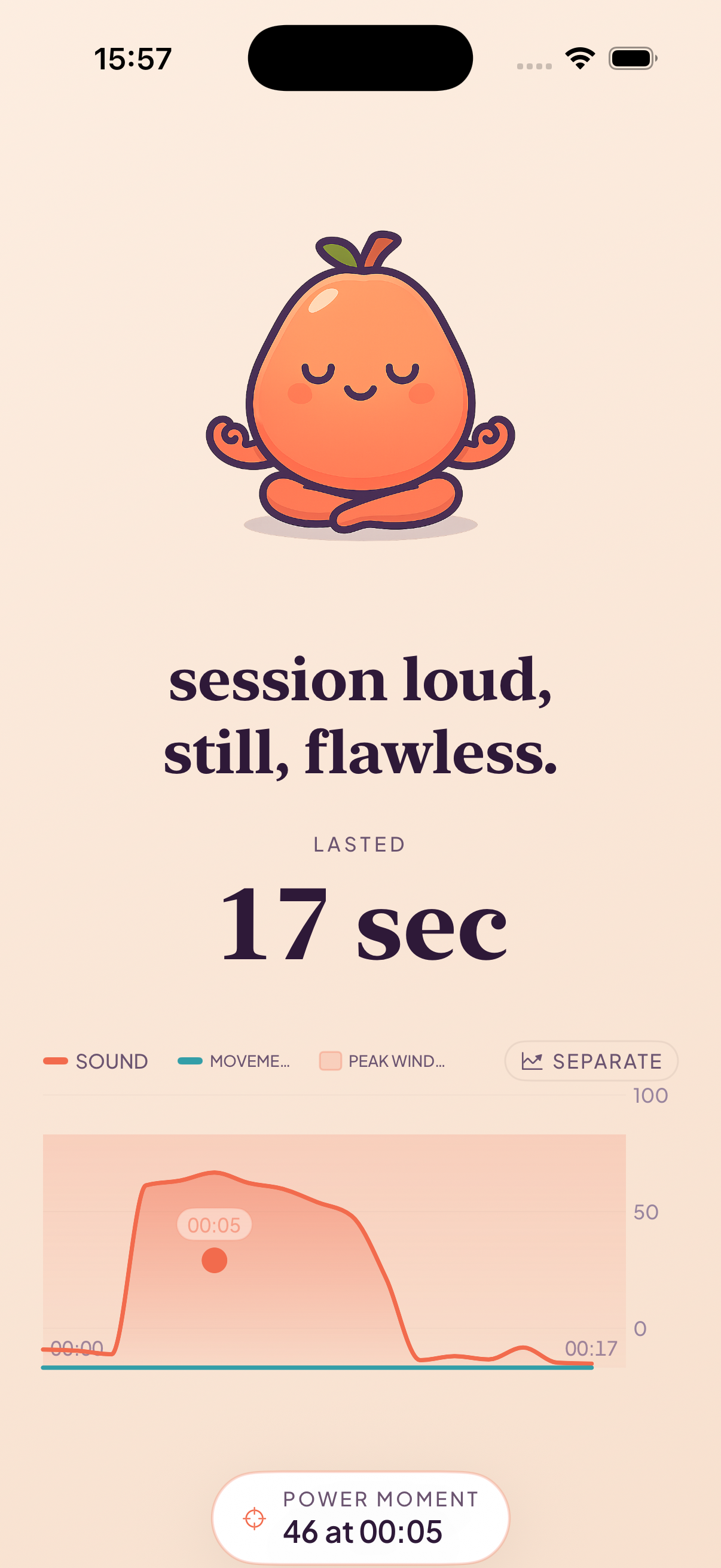
Afterward, a warm 30-second story of the night: your rhythm, your waves, a mood archetype, and playful highlights — narrated by a papaya. The kind of thing that starts a conversation.
This isn't a privacy promise — it's the architecture. There's no account and no cloud sync, so there's no server holding your recaps. The microphone only runs during a session, and raw audio is reduced to a loudness number and released the same frame — it's never written to disk. The only network call Papaya makes is to check your subscription with the App Store.*
*One exception, in the name of full honesty: subscribing in Russia — where Apple's in-app purchases aren't available — uses a separate path that verifies your subscription with our server via Sign in with Apple. It sends an Apple token to confirm the subscription, never your session or recap data.
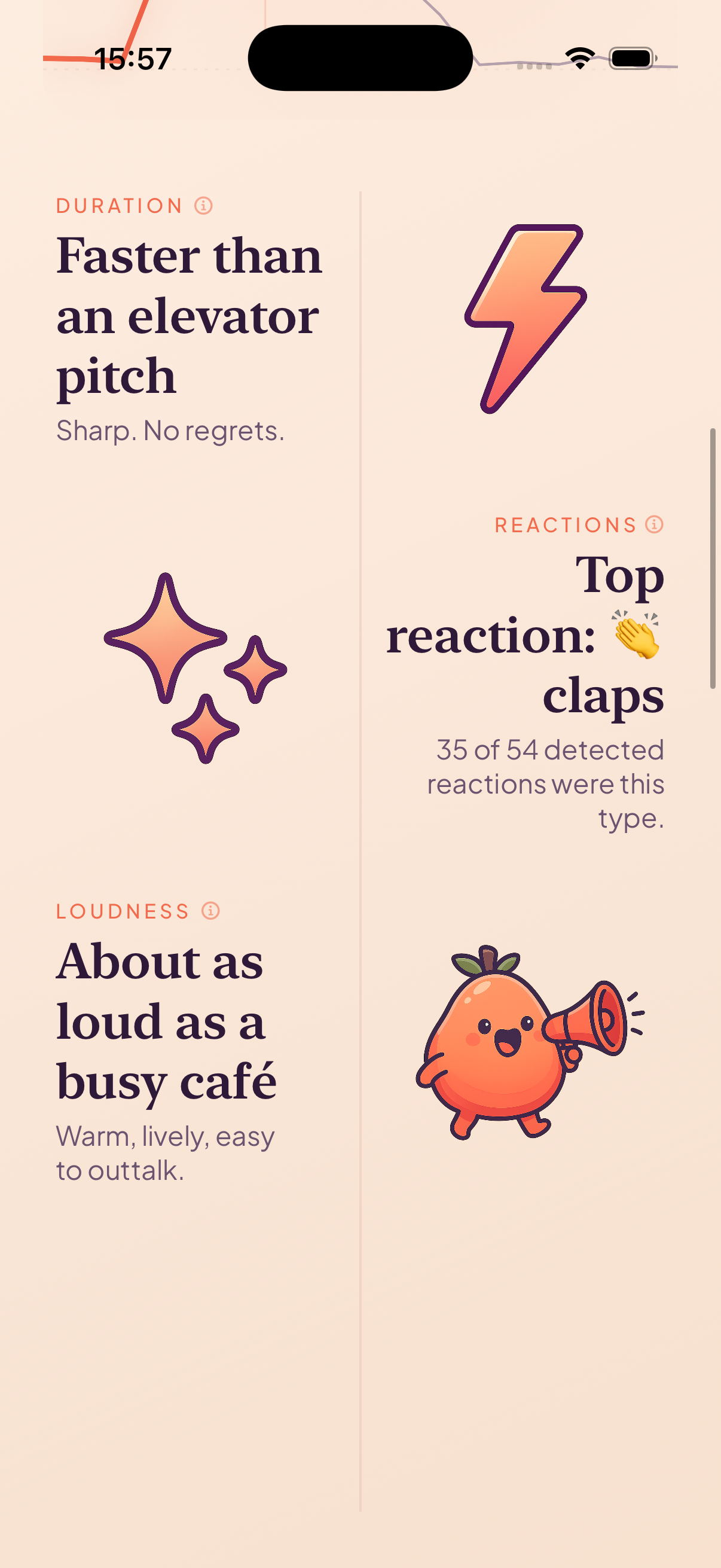
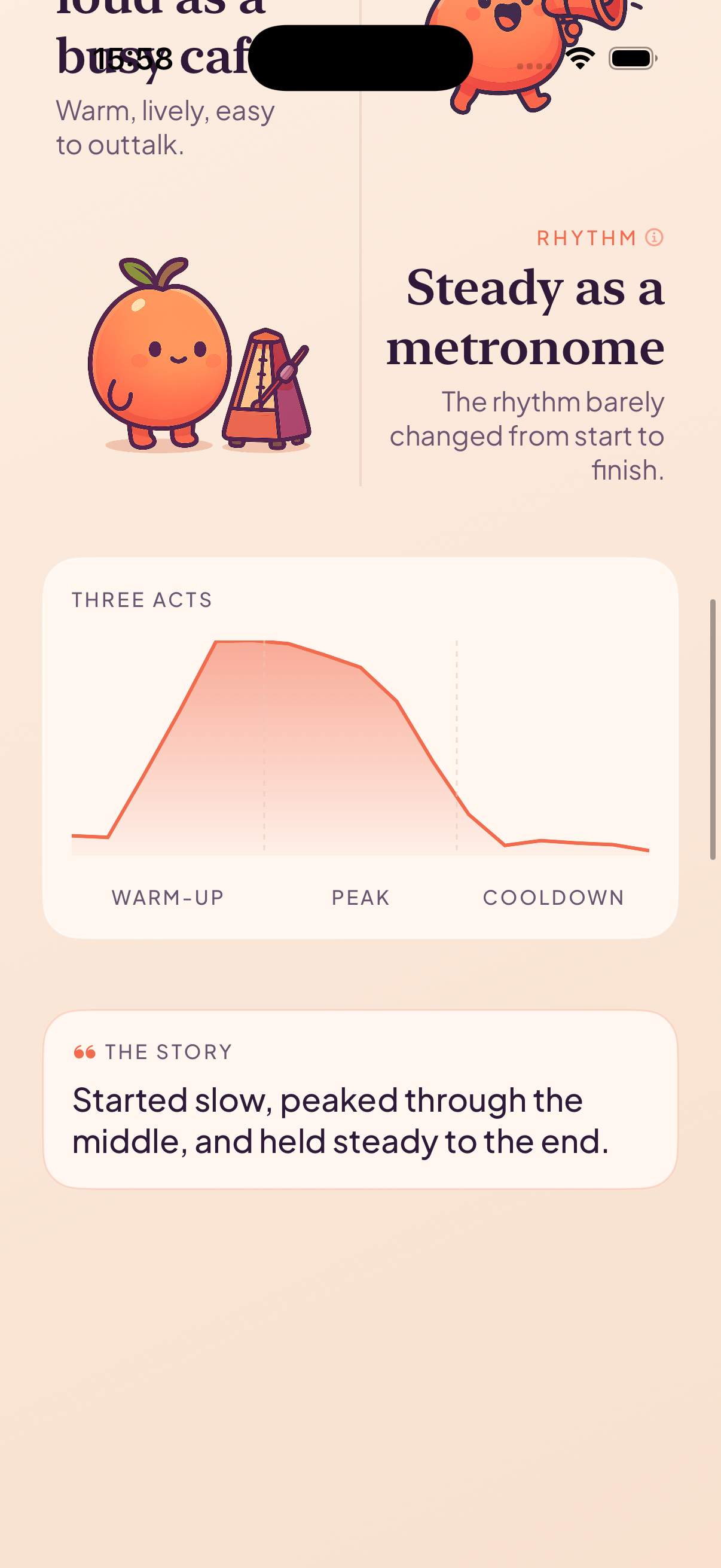
Spotify gives you Wrapped. Papaya gives you the recap of a moment together: an intensity timeline of sound and motion, named "waves," a mood archetype like Three Acts or Steady as a Metronome, and warm, funny highlights — "about as loud as a busy café," "faster than an elevator pitch."
It's narrated by a papaya, because the laugh is what starts the conversation. There's a playful score too, just for the wink of it — you can't "fail," and a quiet night never counts against you.
INTENSITY TIMELINE · ARCHETYPES · MOMENT TAGS

Wear your Apple Watch and Papaya adds heart-rate and recovery context — a read-only window into how a moment together connects to your sleep and how you recharge, with a "true effort" reading.
Read-only is enforced in code. Papaya never writes to Apple Health; it only reads what you allow, and it works completely without a Watch too.
HEART-RATE · RECOVERY · READ-ONLYPair phone-to-phone with a simple QR handshake. A 256-bit key is generated on one phone and handed to the other; it lives only in each device's keychain, never synced to iCloud.
Anything you share with your partner is end-to-end encrypted and travels over AirDrop or Messages — the transport only ever sees ciphertext. Unpair, and the key is gone.
QR HANDSHAKE · AES-GCM-256 · UNPAIR DELETES THE KEY
A fair comparison — most apps in this space are genuinely good at what they do. They're just built on accounts and servers. Papaya isn't.
| Cloud couples apps | Papaya this one | |
|---|---|---|
| Where your data lives | On the company's servers | Only on your phone |
| Account / sign-up | Required | None — ever |
| What's recorded | Varies; stored in the cloud | Nothing — only loudness & motion numbers |
| Sharing with your partner | Through their servers | End-to-end encrypted, device to device |
| If they get breached | Your data is exposed | There's nothing to breach |
| The output | Charts, logs, streaks | A playful illustrated recap |
The point isn't that the cloud is evil. It's that in the single most sensitive category there is, "we can't see your data because it never leaves your phone" is a promise only an on-device app can make.
We'd rather tell you this up front than have you find out after downloading.
Not by default. The microphone only runs during a session, and the sound is turned into a loudness number and released the same frame — it's never written to disk. Papaya measures only how loud and how lively a moment is, never what's said. Two things you can opt into, both off by default: attaching a voice or photo memo to a recap (saved on your phone, deleted when you delete the recap), and an on-device conversation transcript (speech-to-text, encrypted, never uploaded — audio itself still never touches disk).
Your recaps, reflections, motion, and any health context never leave your device — there's no account, no cloud, and no analytics. For most people the only network call Papaya makes is Apple's subscription check. The one exception, stated plainly: if you subscribe in Russia (where Apple's in-app purchases aren't available), a separate path verifies your subscription with our server using Sign in with Apple — it sends an Apple token to confirm the subscription, never your session data.
You pair phone-to-phone with a QR code. A 256-bit key is generated on one phone and handed to the other, and it lives only in each phone's keychain — never synced to iCloud. Reflections you share are end-to-end encrypted and travel over AirDrop or Messages, so the transport only ever sees ciphertext. Unpair and the key is destroyed.
Not in the data sense — nothing is stored on a server, there's no leaderboard, and you can't "fail." It's closer to a Wrapped-style recap: a warm, funny illustrated story that gives two people something to laugh at and talk about. The moment is the occasion; the conversation it starts is the point.
No. Papaya works fully on iPhone alone. If you do wear a Watch, it adds optional, read-only heart-rate and recovery context — Papaya never writes to Apple Health.
Free gives you 3 full recaps your first week, then one each week — the whole experience, not a demo. Papaya Pro ($4.99/month or $39.99/year) unlocks unlimited sessions, full history, trends, themed styles, and personalized insights. New subscribers start with a 7-day free trial. During the launch you can redeem PRODUCTHUNT for 3 months of Pro free.
Not yet — iPhone only. A big part of the privacy story is leaning on Apple-native pieces: on-device ML, the keychain, and encrypted AirDrop handoff. Porting those guarantees to Android is real work, not a recompile.
A warm, illustrated recap of a moment together — that physically can't leave your phone.